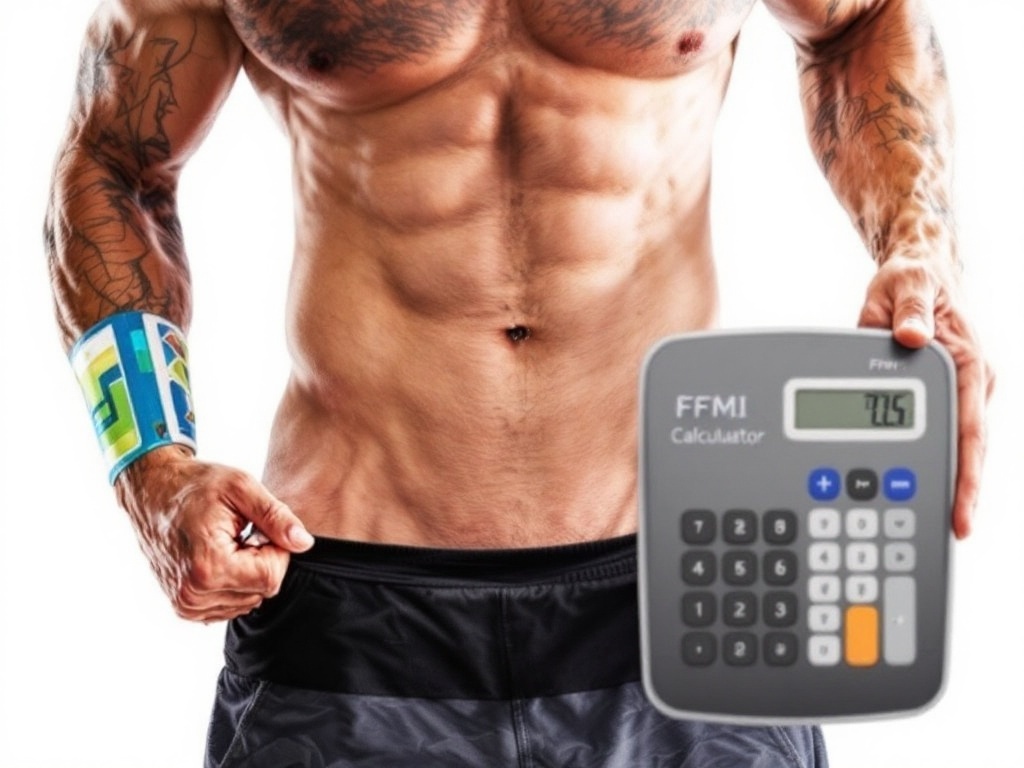
Updated 23 September 2026. Fat-Free Mass Index (FFMI) can be a useful way to describe how much fat-free mass a person carries relative to height, particularly in sport and body-composition research. It is not, however, a superior replacement for every other health measure—and it cannot tell you whether someone is “natural”, using anabolic steroids or has reached a biological muscle limit.
Earlier FFMI coverage on BetterCare described FFMI as “better than BMI”, promoted a so-called “natty limit” and implied that a calculator could reveal natural muscle potential. Those claims were too strong. This guide explains what FFMI measures, how it is calculated, where the famous FFMI 25 idea came from and why measurement error and population differences matter.
What is FFMI?
FFMI stands for Fat-Free Mass Index. It adjusts fat-free mass for height in a way that resembles how BMI adjusts body weight for height.
The basic formula is:
FFMI = fat-free mass in kilograms ÷ height in metres²
Fat-free mass includes more than skeletal muscle. It also includes bone, organs, body water and other non-fat tissues. That distinction is important: FFMI is a measure of fat-free mass relative to height, not a direct measurement of muscle mass alone.
How do you calculate fat-free mass?
If you have an estimate of body-fat percentage, a simple calculation is:
Fat-free mass = body weight × (1 − body-fat fraction)
For example, if a person weighs 80 kg and a body-composition device estimates 20% body fat:
- estimated fat mass = 80 × 0.20 = 16 kg;
- estimated fat-free mass = 80 − 16 = 64 kg;
- if height is 1.75 m, FFMI = 64 ÷ 1.75² ≈ 20.9 kg/m².
The arithmetic is easy. The difficult part is whether the body-fat estimate used to calculate fat-free mass is accurate.
Why the body-fat measurement matters so much
A calculator can only be as accurate as the numbers entered into it. Most home FFMI calculators depend on body-fat percentage from a smart scale, handheld impedance device, skinfold estimate or another method.
A 2026 systematic review of bioelectrical impedance analysis found substantial individual disagreement between BIA estimates and a four-compartment body-composition model. This means a smart scale can produce a repeatable-looking number without necessarily giving a precise individual body-fat percentage.
If the body-fat estimate is wrong, calculated fat-free mass and FFMI will also be wrong.
FFMI is not the same as skeletal muscle index
One of the most common misunderstandings is treating all fat-free mass as muscle.
Research has shown that skeletal muscle represents only part of fat-free mass. A study examining limitations of fat-free mass as a marker of muscle found that skeletal muscle accounted for roughly half of fat-free mass in the adults studied.
So an FFMI increase may reflect muscle gain, but hydration, glycogen, bone and other fat-free components also influence the measurement.
What is a “normal” FFMI?
There is no single universal normal value for every adult.
FFMI varies with sex, age, body size, ethnicity, athletic background and the method used to estimate body composition. For example, a large reference study in European adults found different FFMI distributions for men and women, while another large study found variation across age, sex, region and ethnicity.
That makes rigid internet charts—such as “18 = average, 22 = excellent, 25 = genetic maximum”—far too simplistic.
Where did the famous FFMI 25 “natural limit” come from?
The idea is largely associated with a 1995 study of 157 male athletes. The researchers compared reported anabolic-androgenic steroid users with non-users and found that the height-adjusted FFMI values of the non-user sample extended to around 25.
That study was interesting and influential, but it was never proof that 25 is a universal biological ceiling for drug-free humans.
The sample was male, relatively small and drawn from a particular athletic population. Self-reported drug-use history also has limitations. A research observation in one group should not be turned into an internet lie-detector test.
Can a natural athlete have an FFMI above 25?
Yes, values above 25 have been documented in athlete cohorts that should make people cautious about treating the number as an absolute limit.
A study of collegiate American football players found many athletes above 25, while a larger collegiate football sample reported position-specific values that sometimes exceeded the old threshold.
A 2024 review of FFMI in collegiate sport also concluded that more data are needed to establish optimal ranges across sexes, sports and positions.
So FFMI above 25 is not proof of steroid use, and FFMI below 25 is not proof that someone is drug-free.
Can FFMI detect steroid use?
No. FFMI may describe unusual muscularity in a research or screening context, but it cannot establish whether a person uses anabolic-androgenic steroids.
Drug use is a behavioural and medical question, not something a body-composition formula can diagnose.
Making accusations based on an FFMI score is especially problematic because measurement error in body fat can move the calculated result significantly.
FFMI versus BMI: which is better?
They answer different questions.
BMI uses total body weight relative to height. It is simple, inexpensive and widely used to screen weight-related health risk at population and clinical levels.
FFMI uses estimated fat-free mass relative to height. It can add useful information about body composition, particularly for muscular people or athletes.
BMI’s limitation is that it cannot distinguish muscle from fat. FFMI’s limitation is that it depends on a body-composition estimate that can itself be inaccurate.
The professional answer is therefore not “FFMI beats BMI”. It is that FFMI can complement BMI, waist measurement, body-fat estimates, strength and other information depending on the purpose.
What about waist-to-height ratio?
If the goal is general health rather than athletic muscularity, waist measures may be more directly useful than FFMI.
The NHS recommends waist-to-height ratio as an additional central-adiposity measure when BMI is below 35, with the simple message to aim for a waist circumference less than half your height.
FFMI does not tell you where fat is stored and should not replace waist-related risk assessment.
Should women use the same FFMI benchmarks as men?
No. Typical fat-free mass differs by sex, and reference distributions are different.
The original FFMI 25 paper involved male athletes and should not be copied directly onto women. Modern sport data also show that meaningful reference ranges need to consider sex and sport.
Any calculator that gives identical “poor / average / elite” categories to everyone without explaining the source of those thresholds should be treated cautiously.
Does age affect FFMI?
It can. Ageing can be associated with changes in muscle mass and body composition, while activity and resistance training can influence those changes.
For an older adult, a low FFMI might contribute to a broader nutritional or functional assessment, but it is not enough on its own to diagnose sarcopenia.
Clinical sarcopenia assessment can involve muscle strength, physical performance and more specific measures of muscle quantity or quality.
How athletes can use FFMI sensibly
FFMI can be useful when the same athlete tracks it over time using reasonably consistent body-composition methods.
For example, a resistance-trained person might use:
- body weight;
- waist circumference;
- strength performance;
- training logs;
- body-composition estimates;
- and FFMI as one derived measure.
If strength is increasing, waist is stable and FFMI gradually rises across many months using the same measurement method, that can be consistent with increasing fat-free mass.
It is less useful to compare your home-scale FFMI with an athlete’s DXA-derived number from a research paper.
How often should you calculate FFMI?
Muscle gain is slow. Recalculating FFMI every day or every week usually creates noise rather than useful information.
For a recreational lifter, reassessing every several months under similar conditions is often more meaningful. Measure at a similar time of day, use the same device and avoid comparing readings taken under very different hydration or training conditions.
Height-adjusted FFMI: do you need it?
The original 1995 research used a correction intended to normalise FFMI to a height of 1.80 m. Some sport studies also use height-adjusted FFMI because the simple height-squared formula can still behave differently at height extremes.
For ordinary fitness tracking, you do not need to obsess over multiple correction formulas. The most important thing is to know which formula a calculator uses and to compare like with like.
FFMI does not measure fitness
A higher FFMI does not automatically mean better cardiovascular fitness, mobility, health or sports performance.
A runner, climber, football lineman and bodybuilder have very different physical demands. The FFMI associated with success in one sport may be unnecessary or even disadvantageous in another.
Fitness should be measured using outcomes relevant to your goal, such as strength, power, endurance, movement quality or sport performance.
FFMI does not tell you whether your diet is healthy
It is possible to have a high FFMI while eating poorly, sleeping badly or having other health risks. Likewise, someone with a moderate FFMI can be fit and healthy.
Do not let one physique metric become a substitute for broader health measures.
How to use an FFMI calculator responsibly
- Measure height and weight accurately.
- Use the best body-fat estimate reasonably available.
- Enter the measurement consistently.
- Check whether the calculator uses raw or height-adjusted FFMI.
- Compare trends using the same method rather than chasing internet categories.
- Do not use a score to accuse someone of drug use.
- Interpret it alongside waist, strength, fitness and health context.
Common FFMI mistakes
“My FFMI is 25, so I have reached my genetic limit.”
No. The 25 threshold came from one historical study and is not a universal biological ceiling.
“His FFMI is 26, so he must use steroids.”
No. FFMI cannot diagnose drug use, and values above 25 have been observed in athlete cohorts.
“FFMI is scientifically better than BMI.”
They measure different things and have different limitations. FFMI can add body-composition context; BMI remains a useful health-screening measure.
“Fat-free mass means muscle.”
No. Fat-free mass includes muscle, bone, organs, water and other non-fat tissue.
“My smart-scale FFMI changed this week, so I gained muscle.”
Probably not enough information. Hydration and body-fat-estimation error can move the calculated value more quickly than true muscle tissue changes.
Questions that come up around FFMI Calculator Explained
What is a good FFMI?
There is no universal good score. Values differ by sex, age, population, sport and measurement method. Use appropriate reference data rather than one internet chart.
Is FFMI 25 natural?
It can be. The number 25 is not a drug-use cut-off. Some drug-free athlete cohorts have included values above it.
Can women use FFMI?
Yes, but female reference values differ from male values. Do not use male thresholds as though they apply universally.
Does FFMI include bone mass?
Yes. FFMI uses fat-free mass, which includes bone and other non-fat tissues as well as muscle.
Can FFMI track muscle gain?
It can help track fat-free-mass trends if the underlying body-composition method is reasonably consistent, but it is not a direct muscle measurement.
Should I use FFMI instead of BMI?
Not necessarily. For fitness, FFMI may add useful context. For general health risk, BMI and waist measurements still have important roles.
How to use FFMI Calculator Explained sensibly
FFMI is a useful descriptive body-composition metric, particularly for athletes and people interested in muscularity. Its value comes from putting estimated fat-free mass in relation to height.
It should not be promoted as a perfect replacement for BMI, a genetic-potential calculator or a steroid detector. The famous FFMI 25 threshold is a historical research observation—not a universal law.
Use FFMI as one trend among several, understand the error in the body-fat estimate feeding the calculation and focus on actual health and performance outcomes rather than chasing a category.
FFMI scope note: The material below is general fitness information. FFMI is not a diagnostic test for health conditions, sarcopenia or anabolic-steroid use.
For the wider beginner movement framework, see BetterCare’s Move More pillar guide.