A morning stretching routine does not need to be long or dramatic. For most beginners, the useful goal is simply to move through a comfortable range, reduce stiffness after sleep and make it easier to start the day with some movement.
The NHS includes flexibility work within its guidance on improving strength and flexibility, and recommends building activity gradually rather than forcing range. Stretching should feel like a gentle pull, not pain.
This routine is for generally healthy adults. It is not a treatment for persistent pain, a recent injury or a medical condition.
What morning stretching can realistically do
Stretching can help you move joints through a comfortable range and may make you feel less stiff. It does not need to “fix posture”, detox the body or permanently lengthen every tight muscle.
If you have been inactive for a while, morning stretching can also act as a bridge into more activity later in the day.
Before you start
- Move slowly rather than bouncing.
- Use a wall or chair if balance is uncertain.
- Do not force a stretch into pain.
- Breathe normally.
- Stop if you feel dizzy or unwell.
If stiffness is severe, one-sided, worsening or linked to swelling, weakness or a recent injury, get individual advice instead of repeatedly stretching through it.
A simple 10-minute morning stretching routine
1. Neck turn
Sit or stand tall. Slowly turn your head to the right until you feel a gentle stretch, return to centre, then turn to the left. Repeat 3 to 5 times each way.
Keep the movement small if your neck feels sensitive.
2. Shoulder rolls
Lift your shoulders gently, roll them back and down, then repeat 5 times. Change direction for another 5 circles.
3. Chest opener
Stand tall or sit away from the back of a chair. Draw your shoulders gently back and let your chest open. Hold for 10 to 20 seconds without forcing the arms behind you.
4. Upper-back reach
Clasp your hands in front of you and gently reach them forward while allowing the upper back to round slightly. Hold for 10 to 20 seconds, then release.
5. Side reach
Raise one arm overhead and lean gently to the opposite side. Return to centre and repeat on the other side. Keep both feet planted.
6. Standing calf stretch
Place your hands on a wall. Step one foot back and keep the heel down while bending the front knee slightly. You should feel a stretch in the calf of the back leg. Hold for 15 to 30 seconds, then change sides.
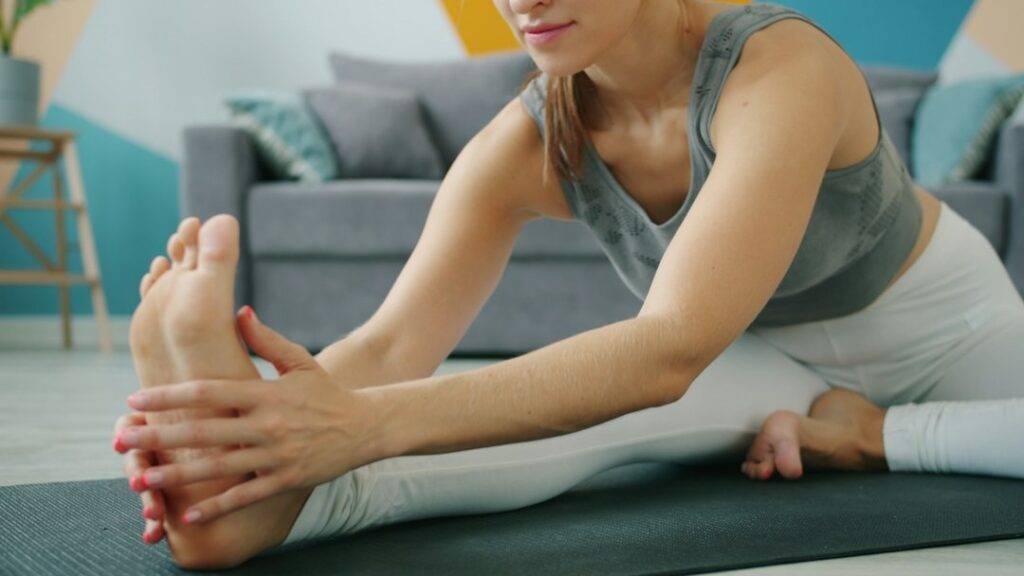
7. Supported hamstring stretch
Place one heel slightly in front with the knee soft. Hinge forward gently from the hips while keeping the back comfortable. Stop when you feel a mild stretch behind the thigh.
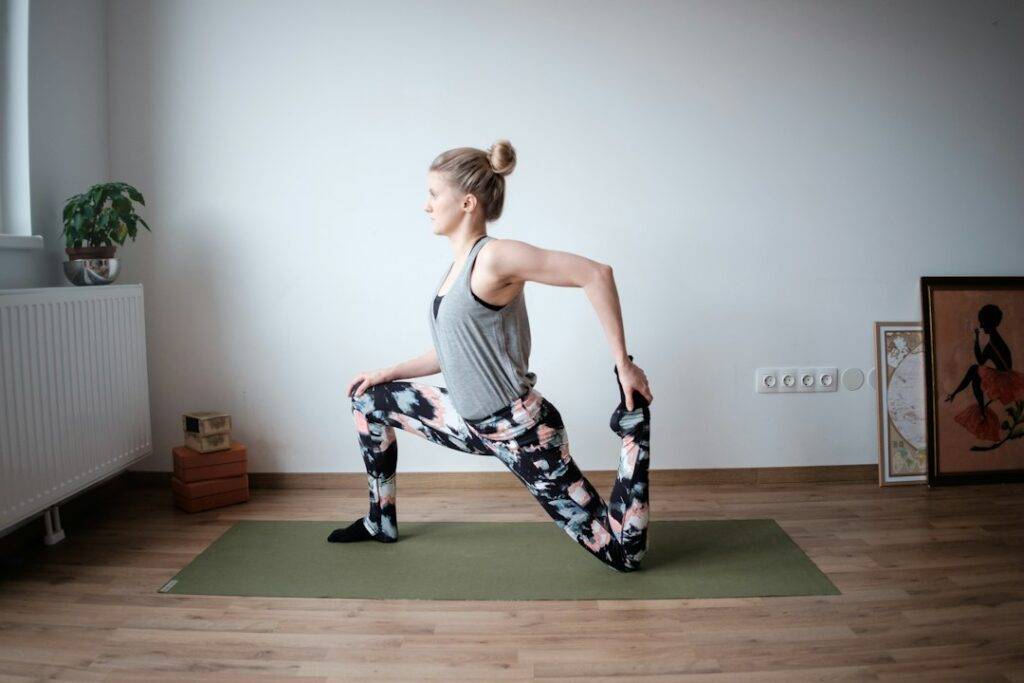
8. Hip-flexor step
Take a small staggered stance. Gently tuck the pelvis and shift weight forward until you feel a stretch at the front of the back hip. Keep the range small and controlled.
9. Ankle circles
Hold a chair if needed. Lift one foot slightly and make slow ankle circles. Repeat in both directions, then change sides.
10. Easy march
Finish by marching gently on the spot for 30 to 60 seconds. This changes the routine from static stretching into light movement before you start the rest of your day.
How long should you hold a stretch?
You do not need extreme holds. For a simple beginner routine, 10 to 30 seconds is usually enough for static stretches. Dynamic movements such as shoulder rolls and neck turns can be repeated several times instead.
The NHS advises gradual progression and controlled movement. If a stretch becomes painful, reduce the range.
Should you stretch before breakfast or after?
Either can work. The best time is the time you will repeat consistently. If you feel light-headed when exercising before food, have breakfast first or keep the routine very gentle.
Hydration, medications and your own health circumstances may affect what feels best.
Morning stretching and walking
A short stretch routine can be followed by a walk. If you are building a walking habit, BetterCare’s walking plan for beginners gives a gradual six-week structure.
When outdoor walking is not practical, use the indoor walking workout instead.
Morning stretching and strength work
Stretching is not a substitute for strength training. NHS guidance recommends muscle-strengthening activity for the major muscle groups on at least two days per week.
If you are ready to add that, BetterCare’s beginner home strength workout is designed for people starting without a gym.
What if you wake up very stiff?
Start smaller. Sit on the edge of the bed, move your ankles, roll your shoulders and gently turn your head before standing. You can do the rest of the routine later.
If morning stiffness lasts a long time every day, is getting worse or comes with swollen joints or other symptoms, discuss it with an appropriate healthcare professional.
What if stretching makes you sore?
Stretching should not create sharp pain or leave you significantly sore. Use less range, shorten the hold or remove that movement.
More intensity is not automatically more effective.
A five-minute version for busy mornings
- 5 shoulder rolls each way;
- 3 neck turns each side;
- 20-second chest opener;
- 20-second calf stretch each side;
- 20-second hamstring stretch each side;
- 30 seconds of gentle marching.
This is enough to establish the habit. Longer is optional.
How to build a morning movement habit
Attach the routine to something you already do: after brushing your teeth, while the kettle boils, after feeding a pet or before opening your laptop.
Keep the first version short enough that you can repeat it even on busy days.
Do you need yoga to improve flexibility?
No. Yoga can improve flexibility and strength for many people, but it is not required. Simple controlled stretches can be useful on their own.
If you prefer gentler whole-body movement, BetterCare’s article on Tai Chi and Qigong explains another low-impact option.
How morning stretching differs from mobility work
Stretching usually focuses on holding or moving into positions that lengthen muscles. Mobility work combines range of motion with active control.
If you want a broader routine using circles, controlled joint movements and active range, use BetterCare’s beginner mobility routine.
When not to copy a generic routine
Get individual advice if you have a recent fracture or operation, severe osteoporosis with specific movement restrictions, acute nerve symptoms, repeated dizziness, or a clinician has told you to avoid certain ranges.
Generic flexibility advice should never override rehabilitation instructions.
A realistic weekly approach
You can use the routine daily if it feels comfortable, but you do not have to. Three or four mornings a week is enough to create consistency.
Pair the routine with walking, strength work and normal daily movement rather than treating stretching as your only exercise.
The main goal: start moving, not chasing perfect flexibility
A good morning stretching routine should leave you feeling ready to move, not exhausted. Keep it simple, gentle and repeatable.
Ten minutes is enough. Five minutes is still useful. The habit matters more than trying to become dramatically more flexible in a few days.
Common morning-stretching mistakes
The most common mistake is treating the routine as a flexibility test. If you wake up stiff, forcing a deep hamstring stretch or pulling hard on the neck is unlikely to make the morning better. Start with smaller ranges and let movement become easier as you warm up.
Another mistake is staying completely still for long periods. If you spend several minutes holding one position, you may feel more comfortable adding gentle walking or marching between stretches so the routine remains a movement session rather than a series of passive holds.
How to adapt the routine if you sit for work
If your morning leads straight into a desk job, prioritise areas that will soon spend hours in one position: shoulders, upper back, hips and ankles. After the routine, stand up at intervals during the day. BetterCare’s desk stretching guide can help you continue that habit once work begins.
How to adapt it for an older beginner
Use a chair or wall for support, keep the stance wider and remove any movement that makes you feel unsteady. Seated ankle circles, shoulder rolls, trunk turns and knee extensions are all reasonable substitutes for standing versions.
If balance is the main limitation, pair the routine with BetterCare’s beginner balance exercises rather than trying to make the stretches more challenging.
What to do on days when you feel low on energy
Use the five-minute version and stop there. A short routine still maintains the habit. If low energy is persistent, severe or unexplained, do not assume stretching or exercise is the only answer; consider appropriate medical advice.
How to tell whether the routine is helping
Look for practical changes rather than dramatic flexibility gains. Does it feel easier to stand upright after getting out of bed? Are ankle circles smoother? Do you start walking sooner rather than sitting for another hour? Those are useful signs.
You do not need to measure how far your fingers reach towards the floor or compare yourself with online demonstrations.
A simple four-week progression
Week 1: use the five-minute version three mornings.
Week 2: use the full routine three or four mornings.
Week 3: add a short walk or indoor walking block after stretching on two mornings.
Week 4: keep the routine but add one or two strength sessions elsewhere in the week.
Morning stretching versus a warm-up
If you plan to exercise immediately afterwards, do not rely only on long static holds. Add active movements such as marching, arm circles, knee lifts and ankle rocks. These prepare you more directly for walking or strength work.
If you are planning a more demanding workout, a specific warm-up matched to that activity may be more appropriate than a generic stretch routine.
When morning stiffness deserves assessment
Routine stiffness after sleep can be ordinary, but stiffness that is prolonged, worsening, associated with swollen joints, severe pain, fever, weakness or a marked change from your usual pattern should not simply be treated with more stretching. Seek appropriate professional advice.
Reviewed: September 2026. General UK fitness information for adults; not individual rehabilitation advice.